 01865 880 800
 info@redtechnology.com
Keyword matching across product data
Match customer searches against product codes, names, descriptions and attributes.

The Search & Merchandising Engine controls how products are found, ranked and presented across your ecommerce site. It supports the key product discovery journeys customers use every day, including keyword search, category navigation, faceted filtering and product listing pages. It also gives merchants the tools to influence result ordering, promote priority products and align search outcomes with commercial goals. This makes Smart Search more than a site search upgrade. It is a trading tool for improving product discovery, maintaining search accuracy and giving your team more control over the customer journey.
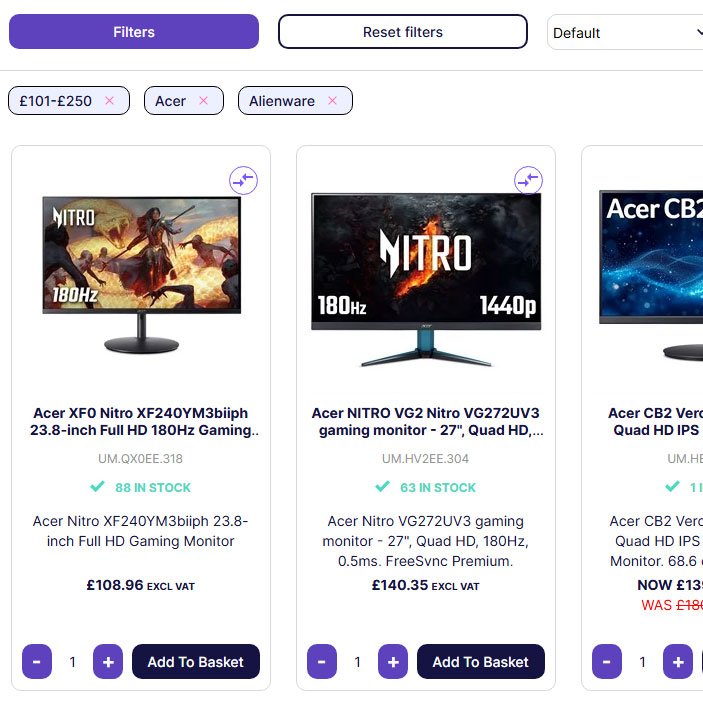
Smart Search provides advanced keyword search for ecommerce catalogues where accuracy, speed and control matter. It matches customer searches against indexed product data, including product codes, names, descriptions and selected attributes. This allows the search experience to support both broad product discovery and precise B2B requirements, such as product code and alias search.
Search behaviour can be configured to suit the structure of your catalogue. Exact product code matches can be prioritised, product names can be weighted more heavily than descriptions, and different matching rules can be applied across different product fields.
Smart Search also includes search behaviours that reduce failed searches and improve result quality without requiring constant manual maintenance.
Keyword matching across product data
Match customer searches against product codes, names, descriptions and attributes.
Product code and alias search
Support B2B customers who search by exact product references, alternatives or known codes.
Configurable search logic
Control how different product fields are matched and weighted.
Prioritised exact matches
Keep exact product code or high-value matches at the top of results where required.
Configurable search passes
Apply different matching strategies across product codes, names, descriptions and other fields.
Search diagnostics
Understand how search results are ranked using in-platform diagnostics and ranking explanations.
Synonym support
Manage synonym rules, including terms that help customers find the same products using different wording.
Fuzzy matching
Help customers recover from common spelling mistakes and typing errors.
Inflection handling
Match different word forms, such as singular and plural terms.
Stop-word handling
Remove non-essential words from searches so customers still receive relevant results.
Partial and match-anywhere search
Allow customers to locate products using partial words or product references where appropriate.
Customers can search in the way that feels natural to them, whether they use product names, codes, partial terms or common misspellings. Smart Search helps return more relevant results while keeping precise matches under control.
Your team can manage search behaviour, ranking and merchandising without relying on bespoke development for every change. Existing search rules, synonyms and merchandising settings can be retained while giving you access to more advanced controls and search diagnostics.
Smart Search also includes merchandising controls that influence how products are ordered and promoted across search results and product listings.
This means merchants can do more than return matching products. They can shape the order of results based on availability, product groups, business metrics and commercial priorities.
For example, you can prioritise in-stock products, promote new ranges, boost products based on performance metrics or apply ranking rules that reflect trading strategy.
Configurable sorting and ranking
Control the order in which products appear across search results and listing pages.
Multiple sort options
Support different ordering choices, such as relevance, price, popularity or custom commercial logic.
Multiple ranking signals
Combine several signals, such as availability, product metrics and product groups.
In-stock prioritisation
Surface available products first, helping customers avoid dead ends.
New product promotion
Promote recently added products using managed product groups and ranking rules.
Product group boosting
Promote or demote selected ranges, brands, campaigns or curated groups.
Metric-based ranking
Rank products using business and engagement metrics such as orders, baskets, page views, reviews, ratings and sales value.
Faceted filtering
Help customers narrow results using structured filters and product attributes.
Category navigation support
Apply search and merchandising control across browse journeys as well as direct search.
Customers see results that are not only relevant, but also commercially useful. Products can be ordered to prioritise availability, popularity, recency or other criteria that improve the buying journey.
Your team can use search as a merchandising channel. You can guide customers towards the right products, support campaign priorities and present your catalogue in a way that reflects your trading strategy.
AI Product Discovery is an optional enhancement to Smart Search. It works alongside traditional keyword search and merchandising rules, extending discovery without replacing the precision and merchant control provided by structured search.
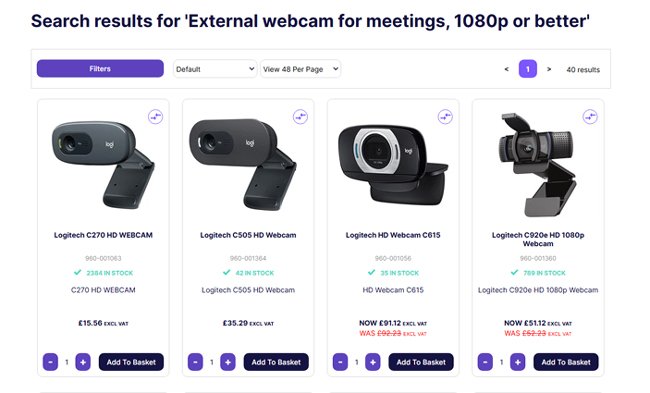
It extends search by introducing meaning-based matching, helping customers find relevant products when their wording does not exactly match the product data in the catalogue.
For example, a customer searching for “trainers” may still find products described as “running shoes”, where the catalogue content supports that relationship.
AI Discovery works alongside keyword search, the keyword search continues to protect exact matches, product code searches, synonym rules and commercial ranking logic.
Meaning-based product discovery
Help customers find products even when their search terms differ from the words used in the catalogue.
Hybrid result ranking
Combine keyword precision with AI-assisted discovery in a single result set.
Reduced zero-result searches
Improve the chance of returning useful results where keyword matching alone may be too narrow.
Configurable behaviour
Tune the balance between keyword matching and AI Discovery so the search experience remains controlled.
Catalogue-aware setup
Configure AI Discovery based on catalogue language, product content quality and search behaviour.
Optional adoption
Enable AI Discovery where it adds value, or keep Smart Search focused on advanced keyword search and merchandising.
Customers get a better chance of finding relevant products, especially when they use different terminology from the catalogue.
AI Discovery adds reach, but keeps control with the merchant. It is best positioned as a discovery enhancement, not a replacement for structured search, product data, filters or merchandising rules.
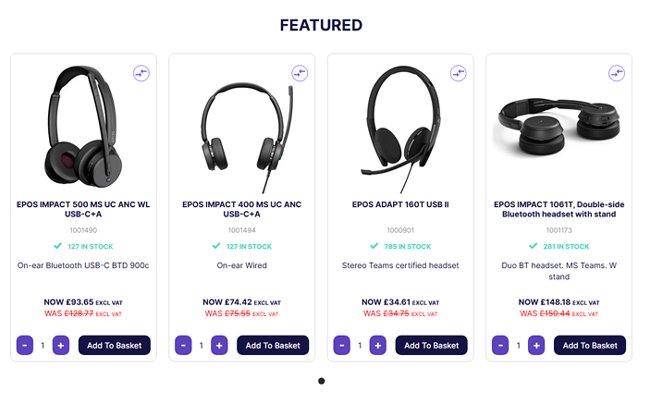
Recommendations complement Smart Search by helping customers discover relevant products beyond their original search.
Where search responds to what a customer asks for, recommendations help surface additional products based on behaviour, context, product relationships and trading priorities.
Recommendations can support cross-sell, upsell and product discovery across different areas of the site, including product pages, category pages and search result pages.
Product recommendations
Present relevant products based on customer context and configured recommendation logic.
Recommendation rules and product relationships
Use configured recommendation rules and product relationships to surface relevant products across the customer journey.
Product relationships
Surface related products, alternatives, complements, bundles or similar products.
Configurable placement
Display recommendation zones across product pages, category pages, search results or other relevant journeys.
Commercial control
Configure which recommendation types are used, where they appear and how they support trading objectives.
Weighted logic
Combine and prioritise different recommendation signals where required.
Customers can discover relevant products without needing to run another search. This supports browsing, comparison, cross-sell and alternative product discovery.
Recommendations give your team another way to surface products, support campaigns and increase product exposure across the customer journey.
Smart Search and Recommendations support different parts of the ecommerce journey.
Smart Search helps customers find products when they have a specific need. It controls how search terms are matched, how results are ranked, how products are filtered and how merchants influence product ordering.
Recommendations extend discovery beyond the original query by surfacing relevant products across the customer journey.
Together, they support both targeted product finding and broader product discovery, giving customers more ways to reach relevant products while giving merchants more control over how the catalogue is presented.